Advance beyond silos through the five stages of exposure management maturity to proactively assess, adapt, and defend against evolving cyber threats.
OVERVIEW
Advance beyond silos through the five stages of exposure management maturity to proactively assess, adapt, and defend against evolving cyber threats.
Throughout the years, Tenable has partnered with thousands of organizations across various sectors to enhance their cybersecurity programs and achieve superior results.
While each company and program is distinct, shared trends exist in how enterprises advance their proactive cyber defenses over the years. Interestingly, even the most sophisticated programs often hit a ceiling despite ongoing spending on personnel and technologies, struggling to scale operations and extract maximum value from their security investments.
The primary reason for this stagnation is the fragmented nature of cybersecurity. While conventional, isolated security measures provide minor gains in visibility, they miss the essential relational context required to generate highly valuable insights.
This is where exposure management comes in.
Exposure management solves this issue by breaking down these barriers and, crucially, supplying the vital context needed to boost analytical insights, team productivity, and overall efficacy. As a result, it elevates security maturity to unprecedented heights.
Exposure management’s relevance in the age of AI
Given how the fast adoption of AI by organizations has increased their attack surface, exposure management has emerged as the best approach for managing AI security risks, such as data leaks and new vulnerabilities, as well as new types of threats, such as direct and indirect prompt injection.
Because the danger of AI often arises from its connections with existing infrastructure and user identities, simply keeping an isolated watch on AI applications is insufficient. Security teams do not need another standalone alert system just to confirm AI is present; instead, they need a comprehensive, macro-level view of their environment.
Exposure management empowers security teams to anticipate, rank, and remediate the most critical AI vulnerabilities, identity flaws, and misconfigurations before they merge into direct attack routes to vital assets. By delivering deep context and visibility across every domain—including IT, OT, cloud infrastructure, identity management, and AI—exposure management illuminates exactly how diverse risks intertwine.
Through exposure management, you gain more than just an inventory of the AI applications your staff utilizes; you understand the depth of AI usage and the specific locations where these AI agents and workloads operate. Most importantly, exposure management highlights how the complex web connecting these AI assets to other network components magnifies your overall attack surface.
Tenable’s exposure management maturity model
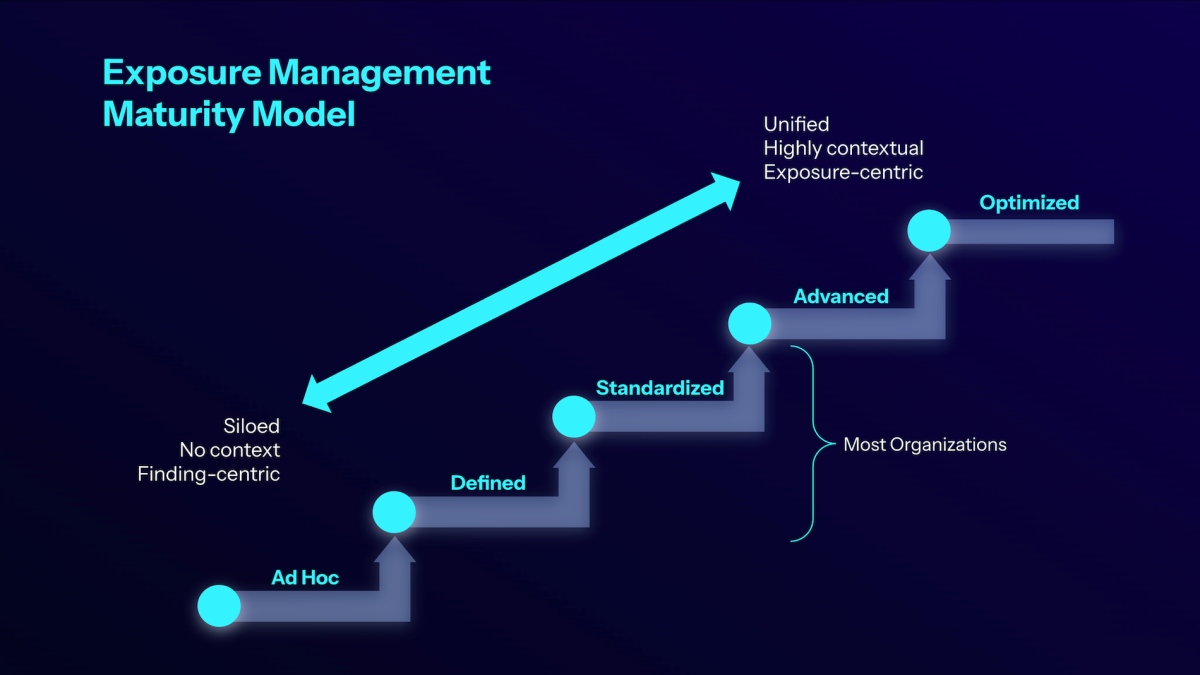
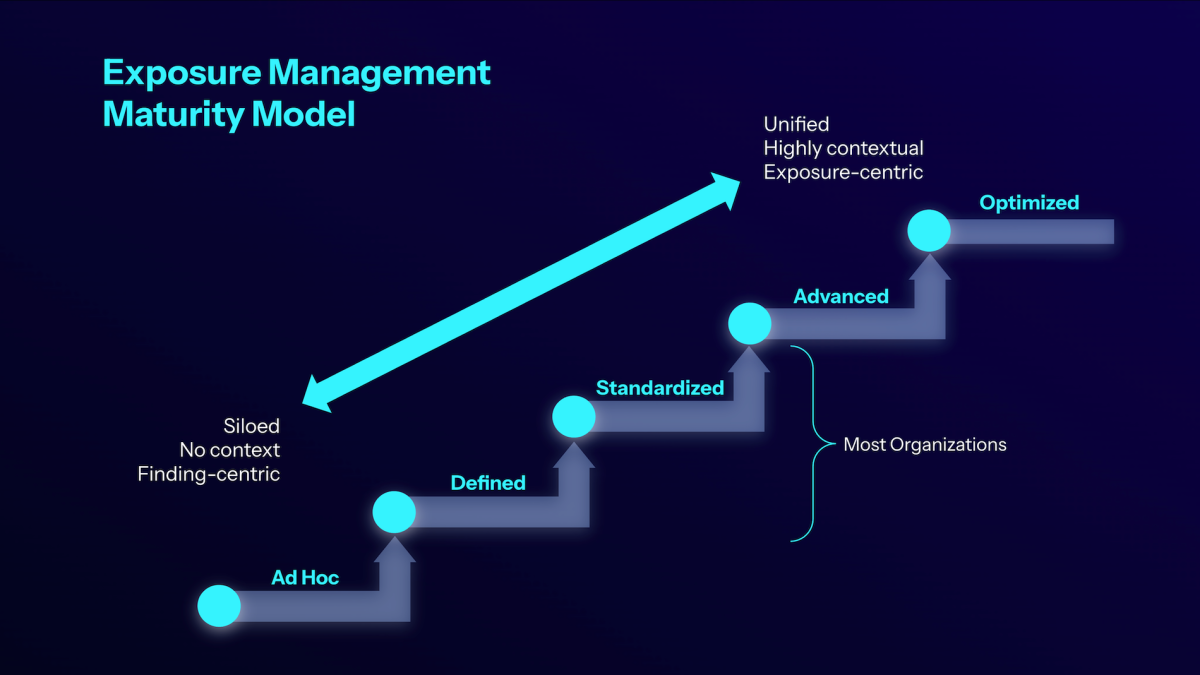
As a pioneer in proactive defense and exposure management, Tenable has observed that cybersecurity programs evolve across five distinct phases: Ad Hoc, Defined, Standardized, Advanced, and Optimized. At the foundational stages, defenses remain isolated, leaving teams blind to the cross-domain links that malicious actors leverage. Emphasizing isolated alerts renders these early-stage programs highly inefficient. Conversely, at the highest maturity levels, enterprises consolidate their data, add deep context regarding asset and identity relationships, and prioritize overall exposure to eliminate alert fatigue.
Let us explore the shared traits that characterize each of these five stages. (Also, see our one-pager on the five stages of exposure management maturity.)
Exposure management maturity model: Stage 1 – Ad hoc
Ad hoc characteristics:
- Limited toolsets
- Predominantly reactive posture
- Absence of formalized procedures
The ad hoc phase represents the baseline maturity tier, where cybersecurity is often a secondary responsibility. Normally, companies at this stage rely on tiny groups of generalists managing both IT and security duties simultaneously. Organizations here typically possess bare-bones technological stacks, often depending on complimentary scanning solutions, basic vulnerability assessors, or the built-in security features of their current IT infrastructure.
Because scanning happens sporadically, significant blind spots emerge, leading to frequent emergency responses. Security personnel remain stuck in a reactive mode, prioritizing basic operational survival over the deliberate minimization of their exploitable attack surface.
During this initial phase, documented workflows and established best practices are generally nonexistent.
Which stage of exposure management maturity best defines your organization? You may be more advanced than you think. Take our exposure management maturity assessment to find out.
Exposure management maturity model: Stage 2 – Defined
Defined characteristics:
- Essential siloed technologies (like vulnerability management and web app scanning)
- Manual but documented workflows
- Adoption of preliminary best practices
Enterprises in this tier have established rudimentary security categories aligned with their current infrastructure size and corporate goals. The majority will have implemented a formal vulnerability management initiative by now. While scanning occurs on a schedule, it is usually restricted just to servers and user endpoints.
Within the Defined level, teams might employ specialized personnel and specific applications to address alternative security areas, including web app assessments or cloud security posture management (CSPM).
Due to fragmented operations and the absence of comprehensive integrations, blind spots likely persist across shadow IT, operational technology (OT), internet-of-things (IoT) devices, and external SaaS platforms. The sheer quantity of alerts coupled with sparse contextual data forces analysts to waste countless hours manually cross-referencing information and filtering out irrelevant noise.
Exposure management maturity model: Stage 3 – Standardized
Standardized characteristics:
- Extensive siloed platforms (e.g., risk-based vulnerability management, cloud-native application protection)
- Advanced workflows featuring increased automation
- Challenges with scalability
Representing some of the most sophisticated cyber programs and largest financial commitments globally, this tier is frequently where companies hit a developmental wall. By now, substantial investments have been made in a wide array of top-tier, specialized applications designed to evaluate every distinct security sector across the expanding attack surface. You employ extensively trained, certified, and specialized professionals dedicated to each specific security vertical. Furthermore, your operational workflows are well-documented, and you are likely leveraging advanced automated processes.
To more effectively align with corporate objectives, these enterprises have rolled out asset tagging and sophisticated risk ranking methodologies, like risk-based vulnerability management, which integrates threat intelligence and asset importance to refine risk evaluations.
However, even with premium tools, expert personnel, and a business-centric perspective on vulnerabilities, keeping up with the escalating volume of alerts and adversary operations remains a struggle. Your environment may contain dozens of disparate tools and suppliers, leading to overlapping capabilities, tedious procurement cycles, and bloated licensing costs. Consequently, certain security executives in this stage attempt to streamline their stack by standardizing on a smaller group of core vendors, aiming to discover fresh operational efficiencies.
The fundamental issue remains the fragmented architecture of these defenses. Because information is locked within disconnected systems, security personnel cannot grasp the critical technical links between identities, assets, and vulnerabilities required to track lateral attacker movement and comprehend the true potential impact on the enterprise.
It is important to highlight that the vast majority of companies currently sit within either the Defined or Standardized maturity brackets.
Exposure management maturity model: Stage 4 – Advanced
Advanced characteristics:
- Consolidated risk and asset information
- Uniform visualization, evaluation, workflows, and analytics
- Enhanced operational efficiencies
Progressing into the Advanced tier requires merging vulnerability and asset intelligence across disparate silos and leveraging it to drive greater efficiency and effectiveness. Over the past few years, the cybersecurity sector has launched multiple initiatives to solve this exact hurdle.
Cyber asset attack surface management (CAASM) platforms attempted to aggregate asset details from various vendor solutions to build one cohesive inventory of the entire attack surface. Likewise, unified vulnerability management (UVM) systems aimed to consolidate risk alerts from multiple sources into one centralized dashboard. Unfortunately, neither approach fully resolves the overarching problem or satisfies all the practical use cases demanded by security operations.
Consequently, numerous companies attempt to engineer their own workarounds by funneling asset and vulnerability metrics from every tool into a centralized data lake. The main obstacle here is that simply merging the data only addresses a fraction of the dilemma. The heavy engineering lift needed to centralize this information and subsequently act upon it—such as orchestrating workflows or generating analytics—falls outside the primary skill set of most security departments. Moreover, maintaining a bespoke, in-house platform quickly becomes financially unsustainable.
This exact friction point is where exposure management platforms (also called exposure assessment platforms) prove invaluable.
Organizations can unlock immense productivity boosts across isolated security functions when their personnel possess standardized methods to:
- View consolidated risk and asset intelligence
- Standardize their risk measurement frameworks
- Execute workflows uniformly
- Streamline internal communications, compliance tracking, and vulnerability reporting
By gathering and standardizing vulnerability and asset details from a wide array of distinct vendor applications, exposure management systems deliver one cohesive perspective of the attack surface, alongside a uniform method for evaluating and articulating the company's overall risk posture.
However, mere consolidation falls short. To truly scale security efforts and extract maximum ROI from existing personnel and technologies, defenders must proactively comprehend the specific business and technical linkages that adversaries target before an intrusion even begins.
Exposure management maturity model: Stage 5 – Optimized
Optimized characteristics:
- Comprehensive business and technical context
- Massively scalable prioritization of attack pathways
- Resource allocation and response driven by exposure metrics
Leveraging artificial intelligence, exposure management technologies construct a resilient data architecture linking identities, assets, vulnerabilities, and frequent MITRE ATT&CK tactics. This allows them to chart realistic attack vectors targeting an organization's most critical assets, like admin credentials or vital servers. Crucially, these mapped routes are the exact trajectories cybercriminals rely on to breach perimeters, traverse networks laterally, and complete their malicious goals.
Once this visual mapping is established, these attack vectors are ranked via comprehensive scoring models that incorporate active threat intelligence, ease of access, exploit likelihood, potential blast radius, and subsequent business disruption, alongside other key metrics. Defenders can immediately concentrate on the vulnerabilities that pose the greatest threat to corporate priorities, factoring in the potential fallout for customers, regulatory standing, or financial revenue.
Instead of attempting to remediate every single isolated alert, teams can target critical structural choke points that carry the highest business risk and largest blast radius, effectively severing numerous attack routes simultaneously. This exposure-focused prioritization facilitates extraordinary gains in productivity and operational scalability.
Are you prepared to launch your own progression toward exposure management maturity?
While every enterprise occupies a unique position on the security maturity spectrum, the Tenable One Exposure Management Platform stands alone in its ability to expedite advancement across all five tiers. By converging fragmented data and injecting deep context throughout your defensive stack, exposure management empowers teams to transcend basic alert handling and begin neutralizing genuine cyber risks.