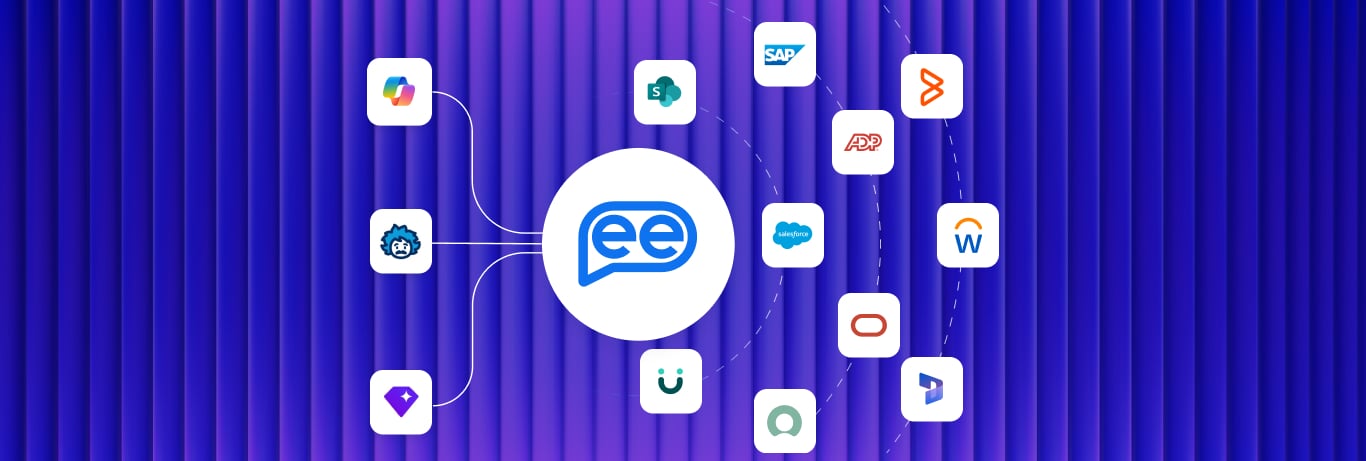
Copilot, Joule, Now Assist — most enterprises are running several agents that can't see each other. Agent-to-agent protocols change that, and they change your governance model with it.
OVERVIEW
Count the AI agents already deployed across your enterprise. Most CIOs land somewhere between four and eight without having made a single deliberate decision to build a portfolio. Copilot came with Microsoft. Joule came with SAP. Now Assist came with ServiceNow. Each was a reasonable purchase. Together they are an archipelago.
The cost shows up on the employee's screen. Someone asks a benefits question in one tool, gets routed, re-explains the situation in a second tool, and re-explains it again to a human. Each agent is individually competent and collectively useless, because none of them can hand work to another one.
The standard fix has been integration projects: point-to-point connectors, custom middleware, a quarter of engineering time per pair of systems. That approach does not survive contact with six agents, because the number of connections grows faster than the budget.
What agent-to-agent protocols actually do
A2A is an open protocol that gives agents a shared language: how to discover one another, exchange context, hand off a task, and confirm an outcome. It replaces bespoke middleware with a common contract.
The practical consequence is that cross-vendor workflows stop being projects and become configurations. That is a meaningful shift in how you plan. Work that used to require a business case and a roadmap slot becomes something a platform team sets up.
There is a second consequence that matters more for budget conversations: existing investments start to compound rather than sit parallel. The Copilot licenses and the ServiceNow agent you already pay for become more valuable without a new purchase, because they can finally participate in the same workflow.
The governance question this raises
The obvious objection is that agents talking freely to other agents sounds like a security problem. It would be, if interoperability meant loosening the boundary.
The architecture worth insisting on does the opposite: every interaction — a direct conversation, a tool call, an agent-to-agent handoff — passes through the same authentication tied to a specific human identity, the same guardrails, the same audit log. Decentralized execution, centralized governance.
The questions to put to any vendor claiming interoperability:
- Is every agent-to-agent call authenticated to a named user, or is there a service account with broad standing access?
- Do PII detection and content moderation apply to agent-to-agent traffic, or only to human-facing chat?
- Is an agent-to-agent handoff auditable end to end, or does the trail break at the boundary?
That third question is where most architectures fail today, and it is the one your auditors will eventually ask.
What this means for how you buy
The walled-garden era of enterprise AI is ending. Evaluating an agent in isolation — feature grid, demo, pilot — misses the variable that will determine its value in three years, which is whether it can work with everything else you own.
Add a line to your evaluation criteria: what open protocols does this support, and what happens to my workflows when I add a seventh agent? Best-of-breed only works if the pieces can talk.